Myfactory is a cloud ERP system for mid sized businesses. The software runs in the browser, you need no server of your own on site, and your staff work from the office, on the road or at home on the same set of data. It is developed and operated in Germany. The manufacturer belongs to the European Forterro group and has around 25 years of experience with cloud software.
One system instead of many islands
In many businesses the data lies scattered: quotations in Word, stock in a spreadsheet, customer contacts in the email program, accounts at the tax adviser. Every transfer by hand costs time and creates a place where errors arise. Myfactory brings these areas together in one database. A customer is created once and is the same customer thereafter in the quotation, the order, the delivery note, the invoice, the dunning process and the reports.
Because the software is built from modules, you do not have to introduce everything at once. The usual start is order processing and inventory management. Production, payroll or the online shop follow later, when they are needed.
What the software covers
- Order processing: quotation, order, delivery note and invoice grow out of one another without data being entered again. Part deliveries, collective invoices and framework agreements are provided for.
- Inventory management: stock, suppliers, customer orders and goods receipts including stocktaking. With serial numbers, batches and several storage locations.
- Financial accounting: general ledger, receivables, payables and assets, with tax returns, several currencies and DATEV handover to your tax adviser.
- Production: parts lists, material requirements, production orders and capacity planning, across several sites as well.
- CRM: contacts, quotations and sales opportunities, linked to the documents of the same customer. Whoever takes the call sees at once what happened last.
- Online shop and till: orders from the shop and sales at the counter run into the same inventory management. Stock figures agree across every channel.
- Reporting: reports and key figures from the running business, as an overview on screen or as a report to pass on.
- Payroll: master data, working hours and pay runs, linked to cost accounting.
How it looks in a working business
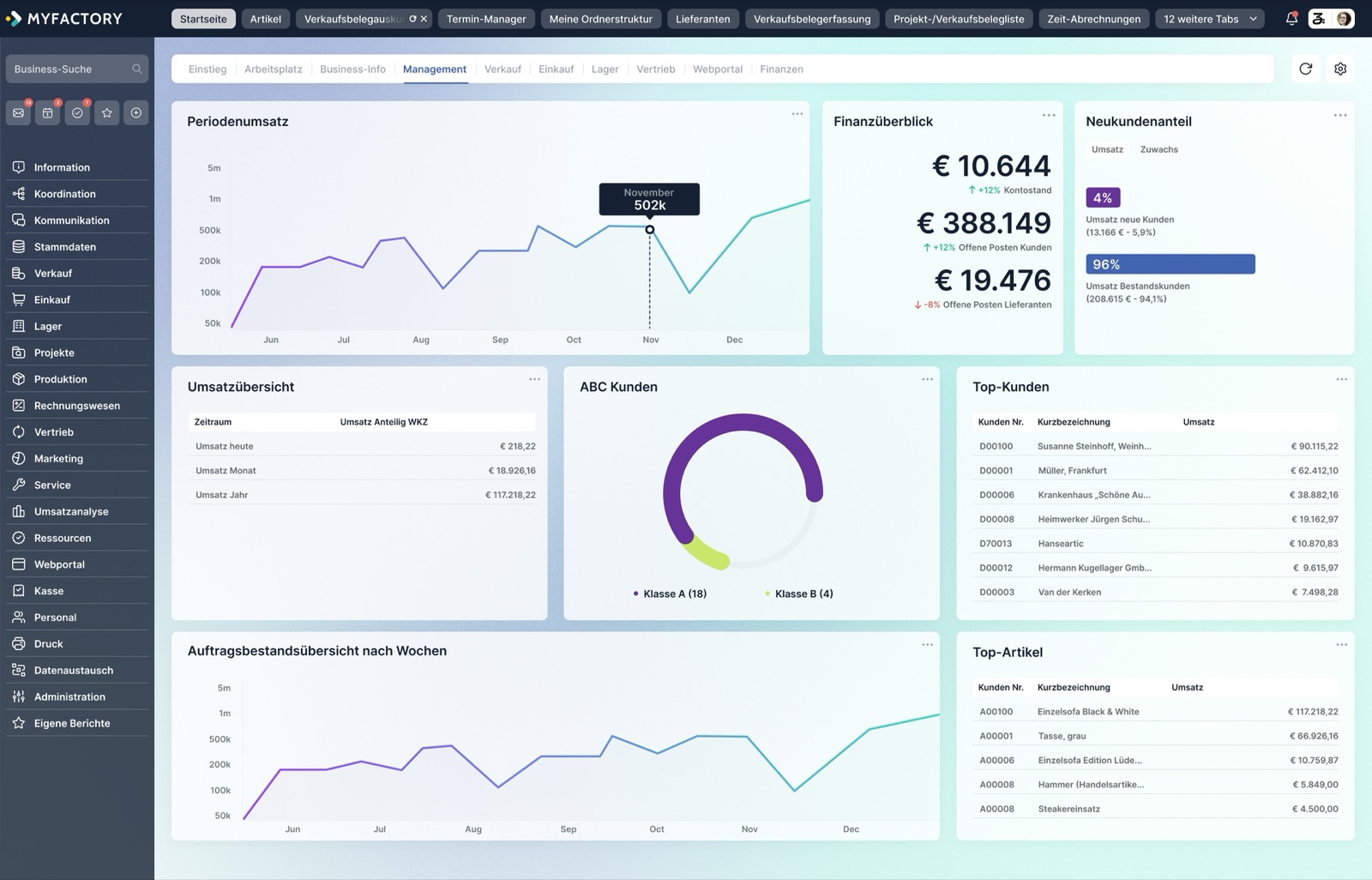
Four views from the running software. The interface was renewed in 2023 and can be arranged for each workplace, so that everyone has in front of them what they actually work with.
The start page shows what each workplace needs. Management sees the revenue curve, the bank balance and the open items, sales sees the order book and the strongest customers. The figures come from the same data that is being worked on right now.
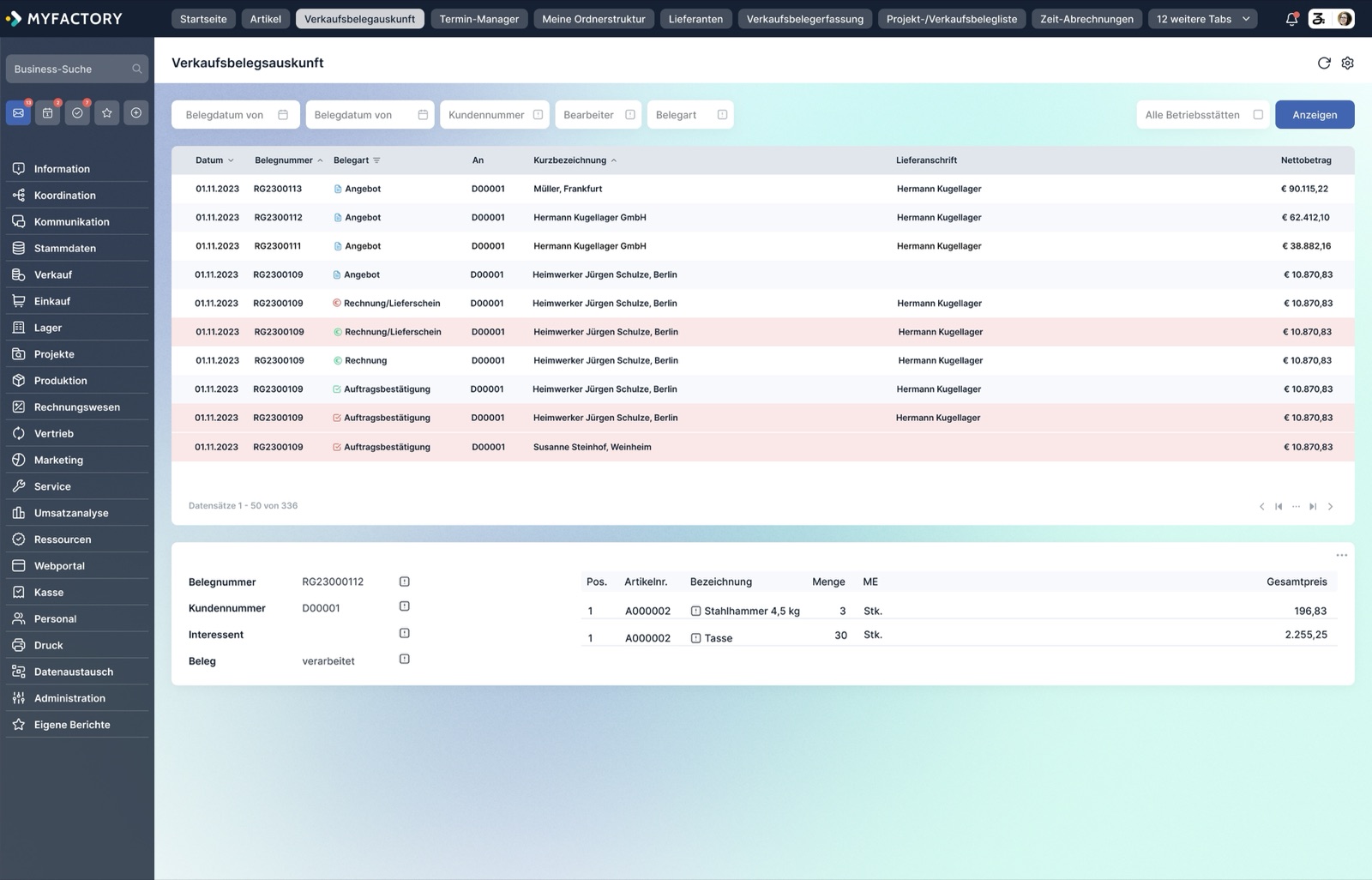
A quotation becomes an order confirmation, that becomes a delivery note, that becomes an invoice. All of them stay linked under the same document number. When a customer rings and asks what became of the quotation from the spring, the answer sits in one list rather than in four folders.
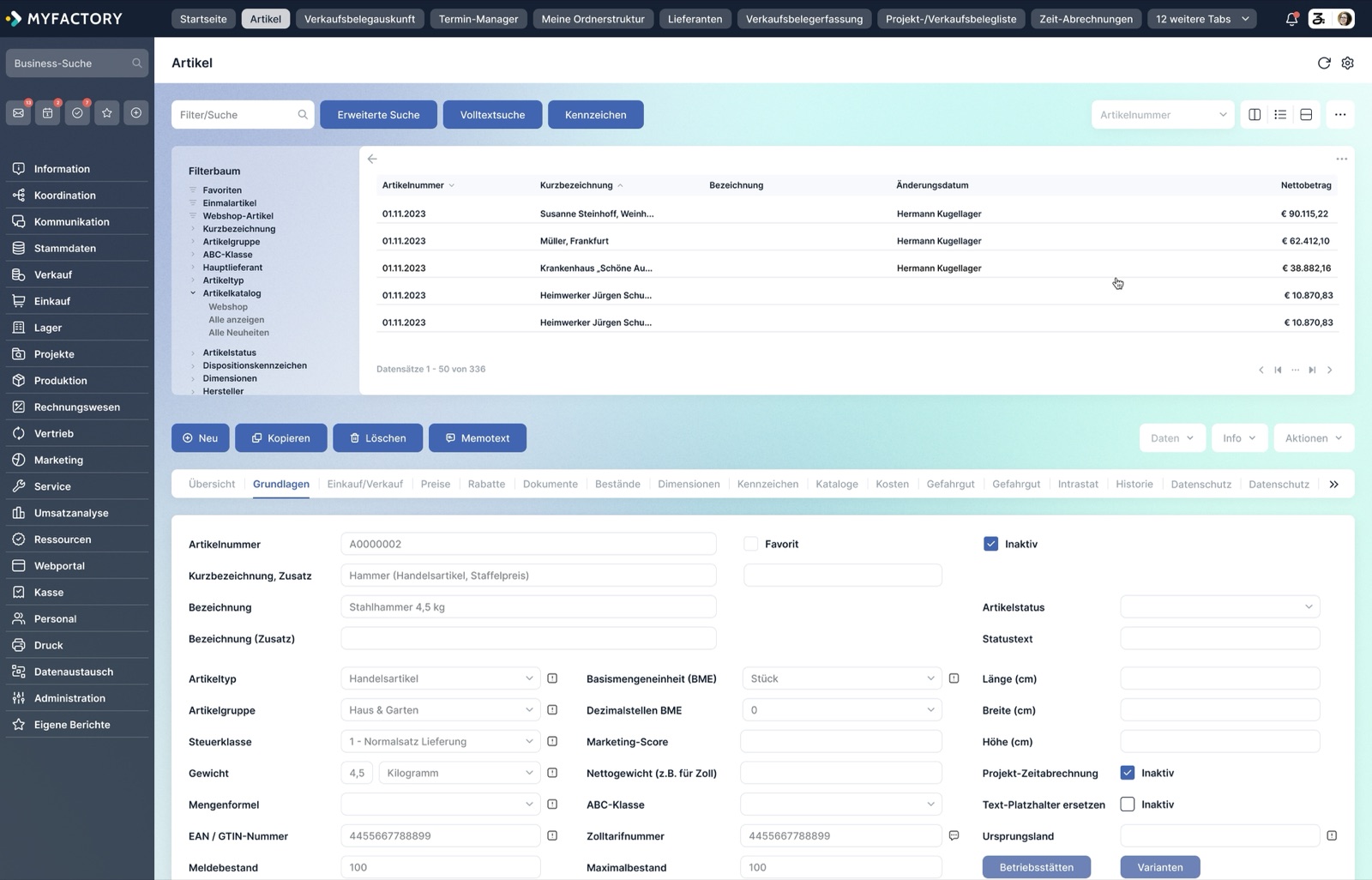
An article has many sides: purchase price, sales price, quantity scales and discounts, stock at each location, weight and customs tariff number for shipping, plus data sheets and pictures for the shop. In Myfactory all of that hangs on the same record, and whoever changes something changes it for every place at once.
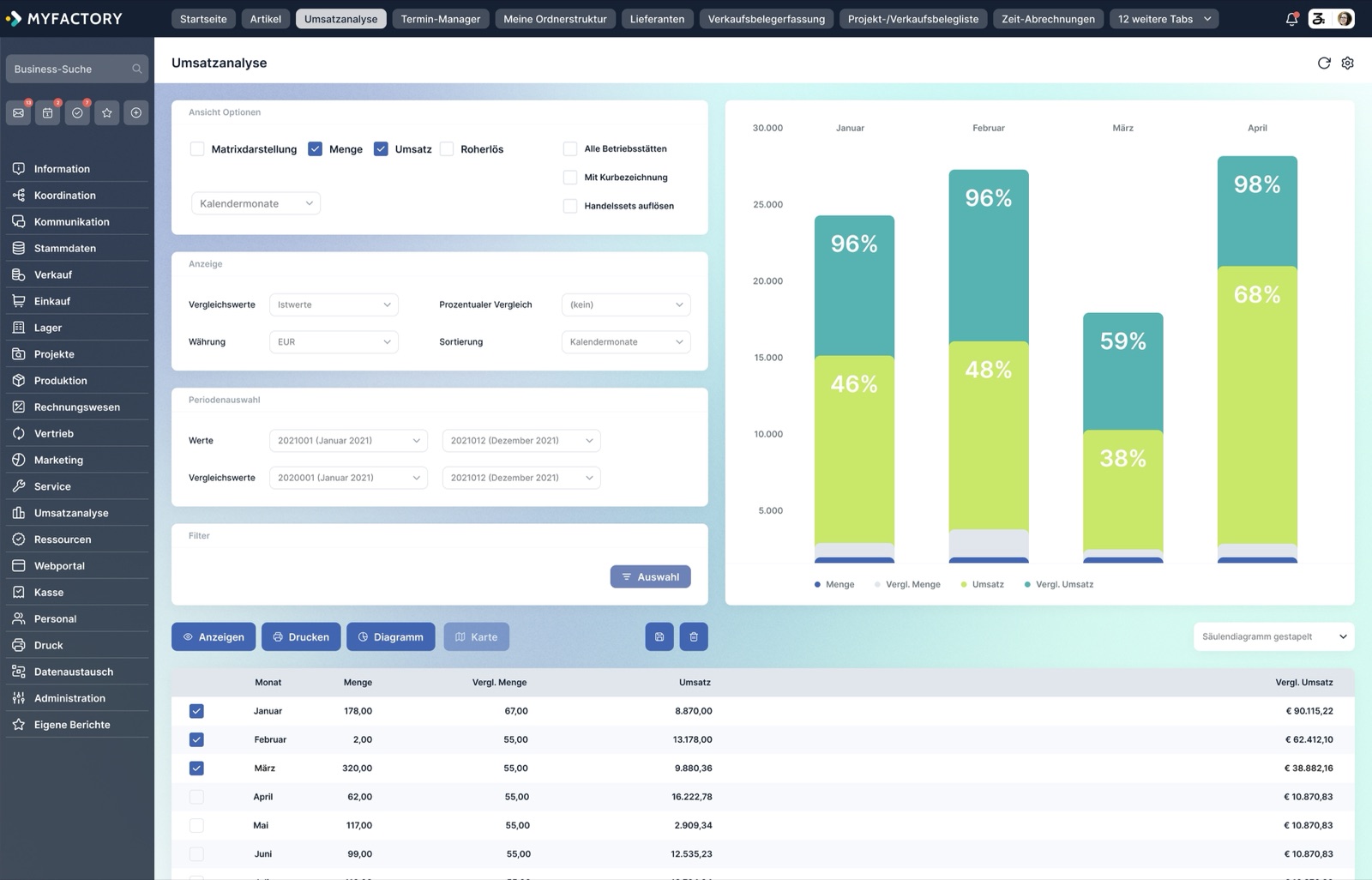
Reports grow out of the data that is there anyway. Choose a period, put the previous year beside it, break it down by article, customer or sales representative, view it as a chart or as a table. Anyone who gathers their figures today from three lists in a spreadsheet is spared that detour.
What may keep running alongside
A new system does not mean everything else has to go. Myfactory brings connections with it that keep your existing programs attached.
Accounts and bank
The handover to your tax adviser runs through DATEV, with document images if you want them. Bank statements come in over Camt and SEPA, payments go out the same way. Credit reports from Creditreform or CRIF can be called up before an order is accepted.
Sales channels
Amazon, eBay and Galaxus are connected, as are shop systems such as Shopware, Shopify and Magento. For shipping there is Shipcloud and ShipXpert, for payment PayPal and Saferpay. Orders land in the same order book as those taken in the office.
Documents and appointments
ZUGFeRD and XRechnung are built in. For filing there are ready made connections to DocuWare, ELO and docuvita. Appointments and contacts synchronise with Microsoft Exchange, so the calendar stays where it is.
For everything else there is an open interface over SOAP and REST. If the route to a program you use is missing, we look at whether it can be built.
E-invoicing: mandatory since 2025
Since January 2025 every company in Germany must be able to receive and process electronic invoices. A PDF attached to an email does not count. What is required is a structured format that a machine can read: XRechnung or ZUGFeRD. For sending there are transition periods, for receiving the obligation already applies.
Myfactory creates and reads both formats. Outgoing invoices leave in the right format, incoming invoices are read in by machine and can be processed further instead of being typed out. Combined with a document management system the document goes straight into the archive and into the approval process.
Where the data sits
The software is developed in Germany and operated in German data centres. For businesses that do not want their data outside the EU, that sets it apart from many internationally sold systems. On request we run the environment in our own ISO 27001 certified data centre.
Which businesses it suits
Myfactory is cut for mid sized companies and is used among others in wholesale, in industrial production, by technical service providers, in medical technology and in e-commerce. The fit is decided less by the sector than by the question of whether you want your processes running together in one system rather than side by side in several.
Who stands behind it
Myfactory has been around for some 25 years, and the software was meant for the browser from the start rather than moved there afterwards. Today more than 22,000 people in over 2,200 businesses work with it. For some years now the manufacturer has belonged to the European Forterro group, which specialises in software for mid sized companies.
For you that means one thing above all: the manufacturer does not depend on how a single product happens to be doing, and the software is developed further rather than merely maintained.
How a changeover runs
No business stands still while its software is replaced. So a changeover runs in stages, and at the start comes not the technology but the way you work.
Take stock
We go through with you how orders run at your place today and where things stick. From that it follows which areas you need and which can wait.
Set up
We map your processes into the software, bring master data across from the old system and fit the documents to your house style.
Switch over
Staff are trained before the switch. In the first weeks afterwards we stay close, because that is when the questions come that nobody saw in advance.
How long it takes depends on how many areas you introduce at once and how clean the data in the old system is. A trading business with order processing and accounting is usually ready sooner than a manufacturer that also maps parts lists and capacity.
What we take on
We set Myfactory up, map your processes into it and train the staff who work with it. That includes bringing your existing data across and designing the documents the way your customers know them. In daily operation you can reach us when something sticks. If a function you need is missing, we add it through the software’s interfaces.
We use Myfactory in our own house as well, from order processing through to accounting. What we tell you about it therefore comes from working with it every day and not from a brochure.
Are you wondering whether the change is worth it? We look at how you work and tell you what it would mean for you, even when the answer is: not yet.